Preface and Chapter One
The Preface
The book begins by listing the credentials of its 3 authors, all of whom happen to be from Queensland, Australia. They mention each person having degrees, but not from where, and insist that they are experts on something they call “creation science.”
The preface of the book makes it very clear that a view of the Bible as literal history is central to the authors’ faith (and indeed, pretends that it is central to the faith of all Christians everywhere). Have some quotes, with notes by me:
“Genesis gives us the true origin (and therefore ultimately the meaning) of not only most major Biblical doctrines, but virtually all of reality—life, death, love, marriage, clothing, mankind, the earth, good and evil, language, the universe itself.” (One would be hard-pressed to find a creation myth from any culture that does not purport to tell the true origins of concepts like these.)
“The truth of the ‘good news’ about Jesus Christ depends totally upon the truth of the ‘bad news’ about Adam’s rebellion against his Maker.” (Here again, we see the idea that the Garden of Eden story must be literal history in order for Jesus to be a god. There is nothing given to back up this assertion, only the repeated insistence that the existence of Jesus is somehow dependent on Genesis being a history book in the modern sense of the word.)
“The Bible is the unchanging, infallible Word of God (as authenticated by the living Word, Jesus Christ.) Where it makes clear pronouncements […] we are totally committed to those by faith.” (The existence of literally thousands of different translations of the Bible is evidence that it is not, in fact, unchanging. Indeed, which books do and do not count as part of the Bible was not officially declared until the Protestant Reformation—which means that for most of the history of Christianity, there was not an officially-defined list of books in the Bible! Catholic and Orthodox Christians even have a longer Bible than the Protestants, because of disagreements about the origins of parts of the Old Testament.)
The preface goes on to point out that most scientists tend to focus on research that presupposes an old earth and the validity of evolutionary theory, whereas very little money is spent on creationist research. They neglect to give the reason: because these theories have literally millions of pieces of evidence proving them, whereas the only “evidence” of a young earth is a particular interpretation of the book of Genesis—one which, I hasten to point out, is not shared by most Christians!
Chapter 1: What Happened to the Dinosaurs?
Credit must be given where credit is due; the first page of Chapter 1 contains only historical fact. To wit: People didn’t know what dinosaur fossils were and assumed they were the bones of giants or monsters. Then, in the 1820s, the remains of Iguanodon were found in a quarry outside of Sussex, and scientists realized that these were the bones of a creature that no longer existed. Creatures of this type were given the name dinosaur, which comes from the Greek for “terrible lizard.” Again, this part is 100% true, and I’m not so petty as to pretend that it isn’t.
It’s the next page where things start to go off the rails. Strap yourselves in, folks, because we’re going to need to explain some things.
The theory of evolution, as postulated by Darwin and refined by later scientists, is as follows:
- Species that are a good fit for their environment continue living there, while species that are not a good fit for their environment either leave or die out.
- When a population is isolated from the rest of the species, genetic drift occurs through mutation. This is a slow process.
- If a mutation happens to allow a species to survive in its current environment, then that mutation will stick around. If a mutation prevents creatures from surviving long enough to breed, then that mutation will die out.
- If the mutations build up to a point that the members of that isolated population can no longer breed with outsiders, then enough change has happened that the two populations are now different species. This process generally takes hundreds or thousands of generations, and is thus easiest to observe in very short-lived organisms, such as bacteria. (And yes, scientists have observed bacteria evolving in the lab.)
That’s it. That is the entire theory of evolution.
The following things are NOT part of the theory of evolution:
- How the very first life forms got here.
- The actual chain of life forms from the first archaea to modern species.
- The origin of the earth and solar system.
- How long ago any given species lived.
- Whether or not any gods exist.
I mention this, because young-earth creationists often falsely claim that these other ideas, which are far outside of the scope of the theory of evolution, are part of it. In short, every scientific teaching which is incompatible with the idea of the earth being less than 10,000 years old is lumped together and called “evolution.” This is a bit like calling all mammals koalas. Koalas are mammals, certainly, but most mammals are definitely not koalas!
Now that we have defined what the theory of evolution is, and what it is not, let’s pick up in the book where we left off.
“Nowadays, everyone has heard of dinosaurs. From kindergarten onwards, we see pictures of them, and as far as most people are concerned, they died out about 65 million years before man appeared on earth.” Again, no lies detected thus far. Then we get to the very next sentence: “This view of the dinosaurs is intimately associated with evolution, which is dogmatic about how life arose by chance, yet surprisingly vague about why creatures such as the dinosaurs died out.” Again, where the first life forms came from is not part of the theory of evolution at all, nor is the method of extinction of any particular species! Ham et al. are beginning their discussion of the extinction of the dinosaurs by insisting that the theory of evolution covers a lot more ground than it actually does. One is forced to come to the conclusion that either they do not understand what the theory of evolution actually says, or they do know and are lying about it.
The authors are not so mendacious as to pretend that the dinosaurs and other Mezozoic creatures did not exist. Obviously they did. Too many fossilized remains have been found, and many of them are on display in museums. They do take great pains to point out that not all reconstructions of dinosaurs have been accurate, and for some reason, they insist on talking for quite a bit about Brontosaurus, a known case of the wrong fossil head being on the wrong fossil body. Brontosaurus, as a species, has been discredited for decades, and had been even when The Answers Book was written. The authors even point out that Brontosaurus doesn’t appear in a 1982 book about dinosaurs (which again, is because the body called Brontosaurus was actually that of a Diplodocus with an Apatosaurus's head on it). It is unclear why the authors would go on for so long about Brontosaurus, unless they are trying to imply that most dinosaur reconstructions are equally faulty.
Indeed, the authors insist that scientists cannot possibly know everything we know about dinosaurs based on fossils, implying that only bones were ever fossilized. The truth is, by 1990, paleontologists had found, not only bones of dinosaurs, but eggshells, skin casts, footprints, coprolite (fossilized poop), and the impressions of feathers. In fact, since the writing of The Answers Book, scientists have found fossilized remains of feathers and skin that contain actual pigmentation, meaning that we even know what colors some dinosaurs were!
And then there is the argument that scientists cannot actually be certain that a dinosaur that has binocular vision, sharp teeth and claws, and other traits of carnivorous animals was, in fact, a carnivore! While some assumptions have to be made, the authors want to pretend that scientific conclusions about which dinosaurs ate which diets are based on a lot less evidence and a lot more conjecture than is actually the case. We’ll see why this is later in the chapter, but take a look at this nasty little cartoon:
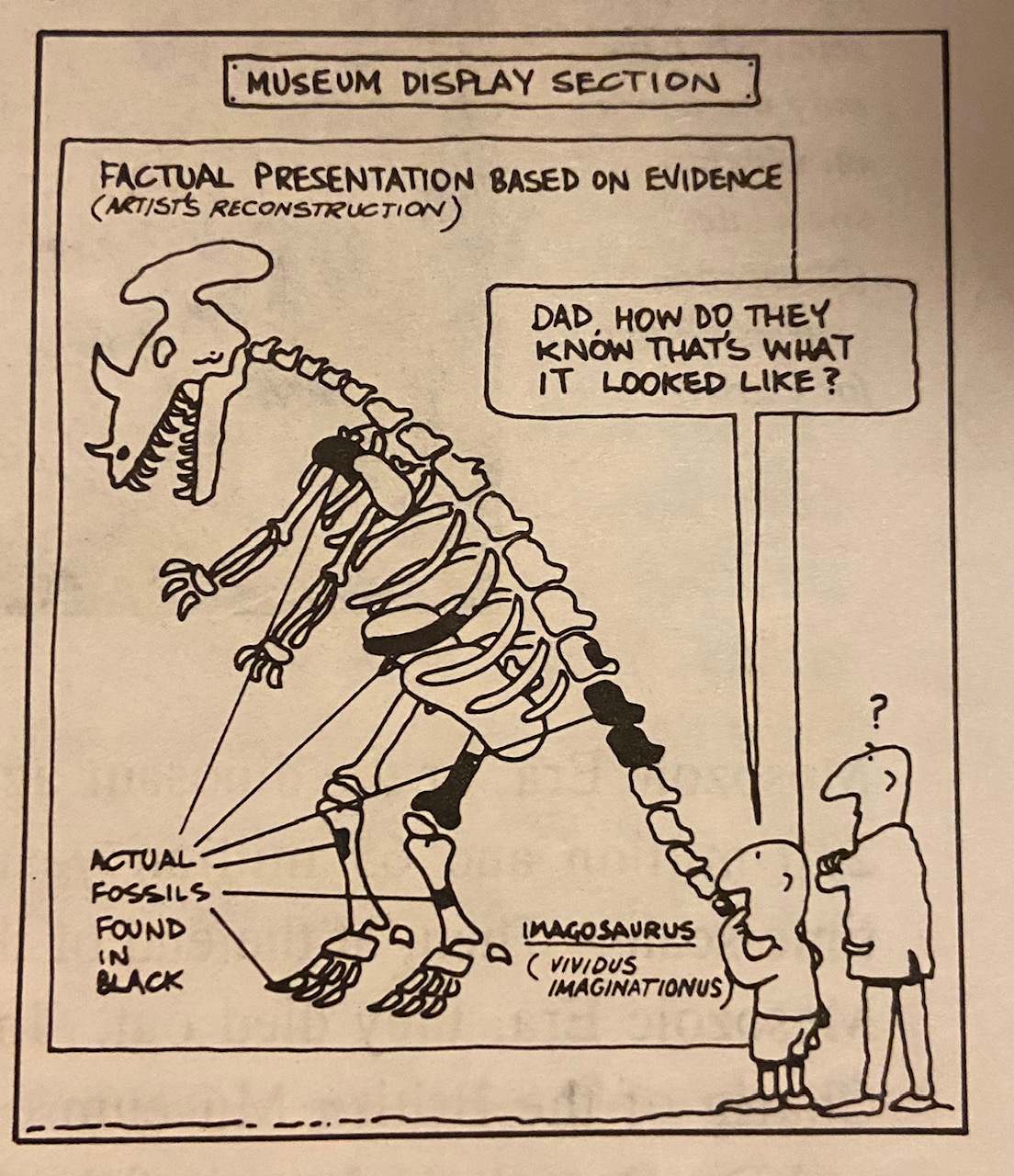
Never mind that some fossil skeletons, even of the exact same species, are far more complete than others. Never mind that literally thousands of fossilized individuals of the best-known dinosaur species have been found and cataloged. Never mind that modern technology allows us to examine fossils in ways that were unthinkable just 50 years ago. The fact that SOME remains of SOME dinosaurs were pitifully incomplete is, apparently, enough to cast doubt on every single dinosaur reconstruction over the past 200 years.
This trend of using cartoons to encourage doubt of scientists and their findings is common throughout the book, and we will see more of it as we continue.
And now, it’s time to discuss why there aren’t any dinosaurs anymore. Here’s how the book describes the prevailing scientific theory, with my own comments in square brackets:
“According to the evolutionary theory, dinosaurs lived on the earth during the Mesozoic era, or the dinosaur age. [This is not part of the theory of evolution, but is a completely separate theory.] … Then, at the end of the Cretaceous Period … they died out.” The book also points out that, at the time of its publishing, scientists had not yet formed a consensus on what exactly caused the extinction of the dinosaurs. If they’d waited just 5 more years to publish, they would have seen that consensus: A massive meteorite struck the earth off the coast of the Yucatan Peninsula in what is now Mexico. The meteorite was large enough that the impact caused major seismic upheaval and volcanic activity, which in turn caused massive clouds of dust to block out the sun in many areas for long periods. Many species of animals, including but by no means limited to the dinosaurs, went extinct at this time.
And again, there is the insistence, now explicit, that paleontologists “have only the bones to work with” and that other parts of dinosaurs have not been fossilized. This is flatly untrue, as I have already pointed out.
“The only way anyone could be sure of what did happen in the past would be through the testimony of any reliable witness who was there. [This goes against quite a bit of science, including the field of forensics. If an eyewitness testimony were necessary to prove anything about the past, then every murder that had no living witnesses would remain completely unsolvable!] And that is what the book of Genesis is. [False; the book of Genesis is a compilation of Hebrew writings about the origin of the Jewish people. There is much evidence within the text itself that it developed over time, which is inconsistent with the idea of it being eyewitness testimony.] It is easy to test this claim. [Which claim? The claim that an eyewitness is necessary, the claim that the authors of Genesis were witnesses of every event depicted in that book, the claim that scientists have only bones to work with, or the claim of how the dinosaurs became extinct? The book is unclear.]”
I’d also like to point out that there is scientific evidence that witness testimony is, itself, not always trustworthy—even if the witness is telling the truth about what they observed! The so-called invisible gorilla experiment is an example of this.
Now that the book has cast doubt on the prevailing scientific theories about when and how the dinosaurs went extinct, the authors need to come up with something to take their place. Here’s what they’ve got for us:
“According to Genesis, land animals and man were made on the sixth day of the creation week […] therefore, those dinosaurs which were land animals [all of them; pterosaurs and sea-dwelling reptiles were not dinosaurs] were created on the same day as the first man, Adam. Both dinosaurs and man inhabited this planet at the same time.”
The book goes on to describe the story of Noah and the great flood, stating that dinosaurs were on Noah’s Ark. While it is true that most dinosaurs were not massive multi-ton giants, and that all dinosaurs hatched from eggs about the size of an ostrich egg or smaller, the claims made quickly begin to strain credulity. “Fewer than 75,000 individual animals would have been needed on Noah’s Ark [there are more species of beetles alone than that], and […] their average size would have been no bigger than a sheep.”
I’m not going to dispute that during a flood, land-dwelling creatures such as dinosaurs would certainly have drowned. One can concede that point without also accepting a global flood as a matter of historical record. However, let’s remember that the argument that dinosaurs were on the Ark implies that not all of them would have drowned! And the authors have an explanation for that, too.
You see, the ancient peoples of southwestern Asia believed that there was water above the atmosphere called the “firmament,” and that that is why the sky is blue. The Hebrews were among the peoples who shared this belief in ancient times. The authors of The Answers Book took this idea and ran with it, claiming that before the great flood (which, again, they treat as a matter of historical fact), there was a layer of water vapor surrounding the atmosphere. (I will discuss the issues with the “vapor canopy” idea as it is brought up in later chapters. For now, it is enough to note that the authors believe such a thing existed.) This vapor canopy, they claim, was the source of 40 days’ worth of rainwater, which flooded the entire earth. Thus, after the great flood, there would be no vapor canopy protecting the earth from radiation. (No word on whether or not the authors believe in the existence of the ozone layer.)
“The world had been denuded of vegetation which was only now newly regrowing. More radiation would be able to reach the surface of the earth, and even the atmospheric pressure … would be lower.” Again, we’re not going to talk about how feasible this is just yet. I’m just putting it out there that this is what the authors apparently believe.
As an aside, the authors then go back to the Garden of Eden story to insist that in the beginning, all living things were herbivores, including lions, tigers, and Tyrannosaurus rex, and that this only changed because of the fall of Adam. They then claim that it was the great flood which first led to humans eating meat. “Man was going into competition with the animals to survive.” Never mind that a vegetarian human race would still have had to compete with herbivores for food. Never mind that large carnivores such as bears would have been a danger to humans, even if humans didn’t consume any meat themselves. No, it was an omnivorous human diet that first caused humans to have to compete with animals for survival!
The authors aren’t done with the story of the dinosaurs yet, though. Pointing out that many species of animal have gone extinct during modern history, they wish to convince us that dinosaurs not only survived the great flood, but may still be among us. No, really.
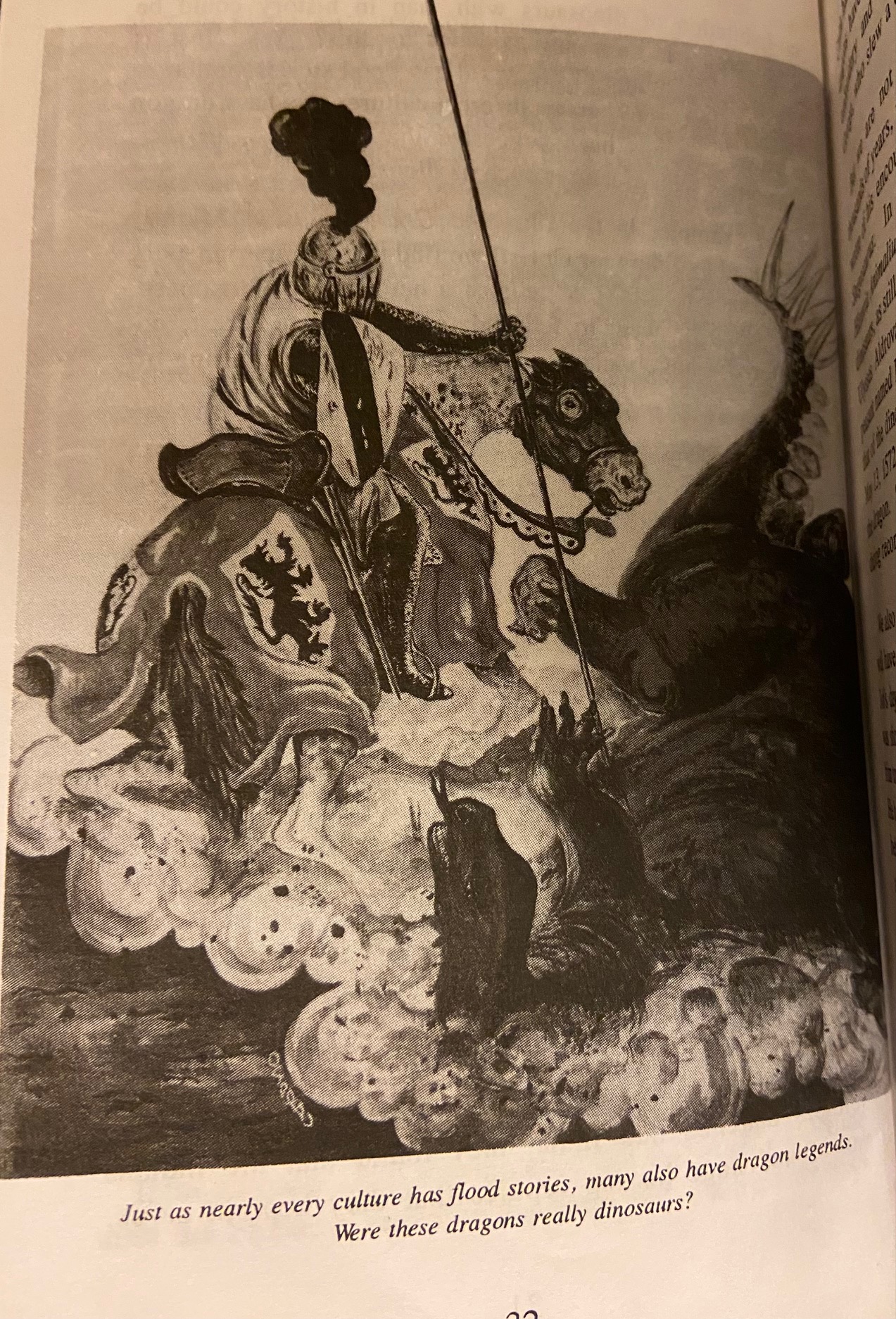
“Just as nearly every culture of the world has flood stories similar to Genesis 6 – 9 [the level of similarity is, in fact, wildly different from culture to culture, and many such floods are described as local], many different cultures also have dragon legends. It has been suggested that these are, in fact, encounters with creatures such as dinosaurs.”
That’s right. The argument is that dragons were real, and that they were actually dinosaurs that survived into historical times.
One example given is the Epic of Gilgamesh, which the book erroneously claims is only 5,000 years old instead of 7,000. And what does this, the oldest written story ever found, have to say? Apparently, when the king Gilgamesh went to cut cedars in what is now Lebanon, he found a dragon and cut off its head. (No word on whether the beast-man Enkidu from that same story was real, presumably because the love between Enkidu and Gilgamesh makes this sort of Christian very uncomfortable.) It’s curious that a blatantly pagan story, which states as fact the existence of other gods and implies that the wiles of a temple prostitute can make a beast into a man, is being cited by a Christian source. Something tells me that Ken Ham and his buddies have never actually read the Epic of Gilgamesh at all.
Other examples of dragon stories that the authors say could have been dinosaurs include medieval stories of knights such as St. George slaying dragons. There’s even a full-page illustration of St. George stabbing a Stegosaurus, which I will admit looks really cool. But that doesn’t mean that it actually happened!
And then there are the alleged sightings of dinosaurs in remote areas in modern times.
“Geologists, the traditional declarers of extinction, have been severely embarrassed several times when, after having declared animals to be extinct, they have discovered them alive and well.” Not true. Scientists are usually overjoyed when an animal thought to be extinct turns out not to be. It means more animals to study!
“It is neither possible nor feasible to have one person at every point on the earth’s surface looking in every direction all at one time, just to be 100 percent sure that there are no dinosaurs, and that, therefore, dinosaurs truly are extinct.” Again, no apparent understanding of context clues from the environment. People couldn’t observe every inch of the island of Mauritius at the same time, either, but they still knew that the dodo had no natural predators because of its complete lack of concern for its eggs. A bird that has natural predators will not just lay its egg wherever it happens to be at the time and then wander off. It will guard that egg fiercely to make sure that its offspring survives.
Similarly, a lack of signs of modern dinosaurs—no spoor, no recent nests, no tracks in the mud, no remains less than 65 million years old—is a pretty good indicator that you’re not going to find a living Triceratops wandering around in the nearest jungle. Absence of evidence may not be evidence of absence, but it certainly doesn’t mean that we can conclude that an animal is there. By the same logic, because we can’t scour the entire earth for unicorns all at once, we can’t rule out the existence of unicorns. Or mermaids. Or any other mythical beast.
The authors also give us the first instance in the book of the made-up word “evolutionist” at about this point. It appears to mean a person who is not a young-earth creationist, or in other words, 99.9% of all scientists, Christian or otherwise.
Chapter 1 finishes up with this bizarre claim:
“There is no real mystery surrounding the dinosaurs when one understands the events that have happened in the past. But our understanding of these events cannot be based on the mere speculations of people who are alive in the present.” Which is odd, because the exact same kinds and amounts of evidence are used by archaeologists all the time to determine what kinds of foods different people ate, or how long Jericho has been settled by humans. A humble garbage heap can speak volumes about how the people who left it behind lived! Calling the use of evidence found at a site “mere speculation” is a grotesque mischaracterization of how research, in general, works.
“Unless they are based on the carefully recorded words of the Creator God who was there, none of us has a basis for any real interpretation of history or evidence at all.” By this logic, we have no evidence of the existence of Chinese emperors from 2000 years ago, because China is not in the Bible. The American and Australian continents must not be real either, because they’re not in the Bible! Raccoons? Kangaroos? Two-toed sloths? Sorry, not in the Bible, so they can’t really exist. I could continue this all day.
This idea that something has to be mentioned in the Bible in order for it to be historical fact is so bizarrely, obviously false, I don’t even know where to begin debunking it. And this is just the first chapter out of twelve. Heaven help us.